Math
All Node Variations
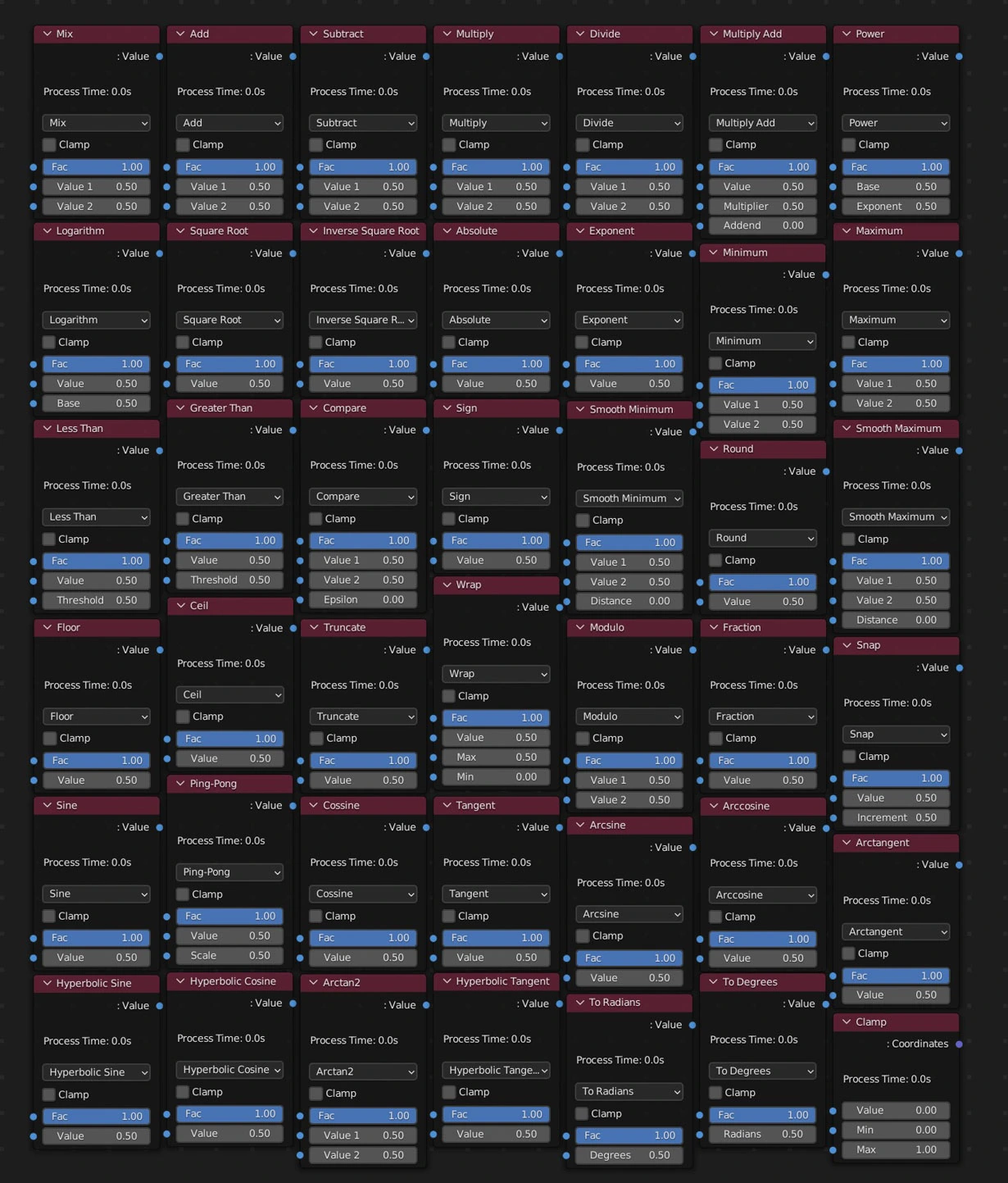
All Math operations have the ability to blend (Mix) between value 1 and the result of the operation
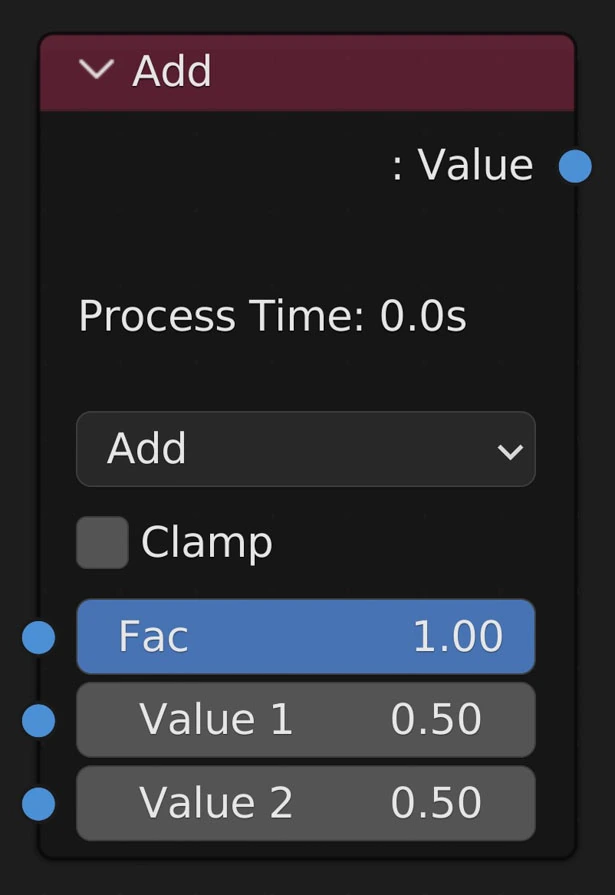
Italicized words are the names of the inputs
Mix
Blend the value inputs via the Fac(tor) input
Add
The sum of the two values.
\(Value 1 + Value 2\)
Example
\(1 + 2 = 3\)
Subtract
The difference between the two values
\(Value 1 - Value 2\)
Example
\(1 - 2 = -1\)
Multiply
The product of the two values
\(Value 1 * Value 2\)
Example
\(3 * 2 = 6\)
Divide
The division of the first value by the second value.
\(Value 1 / Value 2\)
Example
\(\frac{6}{2} = 3\)
Multiply Add
The sum of the product of the two values with Addend.
\(Value * Multiplier + Addend\)
Power
The Base raised to the power of Exponent.
\(Base^Exponent\)
Example
\(3^2 = 9\)
Logarithm
The log of the value with a Base as its base.
\(log_{Base}(Value)\)
Example
\(log_3(3) = 1.0986122886681098\)
Square Root
The square root of the value.
\(\sqrt{Value}\)
Example
\(\sqrt{4} = 2\)
Inverse Square Root
One divided by the square root of the value.
\(\frac{1}{\sqrt{Value}}\)
Example
\(\frac{1}{\sqrt{4}} = 0.5\)
Absolute
The input value is read with without regard to its sign. This turns negative values into positive values.
\(| Value |\)
Example
- \(| -2 | = 2\)
- \(| 5 | = 5\)
Exponent
Raises Euler’s number to the power of the value.
\(e^{Value}\)
Example
\(e^5 = 148.41315910257657\)
Minimum
Outputs the smallest of the input values. Returns the smallest value
\(\min({Value 1}, {Value 2})\)
Example
- \(\min({3}, {7}) = 3\)
- \(\min({10}, {-8}) = -8\)
Maximum
Outputs the largest of two input values. Returns the largest value
\(\max({Value 1}, {Value 2})\)
Example
- \(\max({3}, {7}) = 7\)
- \(\max({10}, {-8}) = 10\)
Less Than
Outputs 1.0 if the first value is smaller than the second value. Otherwise the output is 0.0. Returns 1 if True, 0 if False
\(Value < Threshold\)
Example
- \(3 < 7 = 1 (True)\)
- \(10 < -8 = 0 (False)\)
Greater Than
Outputs 1.0 if the first value is larger than the second value. Otherwise the output is 0.0. Returns 1 if True, 0 if False
\(Value > Threshold\)
Example
- \(3 > 7 = 0 (False)\)
- \(10 > -8 = 1 (True)\)
Sign
Extracts the sign of Value. All positive numbers will output 1.0. All negative numbers will output -1.0. And 0.0 will output 0.0.
Example
- \(sign(3) = 1.0\)
- \(sign(-50.758) = -1.0\)
- \(sign(0) = 0.0\)
Compare
Outputs 1.0 if the difference between Value 1 and Value 2 is less than or equal to Epsilon.
\(|Value 1 - Value 2| \leq Epsilon\)
Example
- \(|0.5 - 0.7| \leq 0.0\)
- Returns 0.0 (False)
- \(|0.5 - 0.7| \leq 0.2\)
- Returns 1.0 (True)
Smooth Minimum
Like the Minimum function but rounded instead of pointed (linear)
Smooth Maximum
Like the Maximum function but rounded instead of pointed (linear)
Round
Round Value to nearest whole number
Example
- \(round(0.5) = 0.0\)
- \(round(0.51) = 1.0\)
- \(round(5.25) = 5.0\)
- \(round(5.75) = 6.0\)
Floor
Round Value down to a whole number
Example
- \(floor(0.5) = 0.0\)
- \(floor(0.51) = 0.0\)
- \(floor(5.25) = 5.0\)
- \(floor(5.75) = 5.0\)
Ceil
Round Value up to a whole number
Example
- \(ceil(0.5) = 1.0\)
- \(ceil(0.51) = 1.0\)
- \(ceil(5.25) = 6.0\)
- \(ceil(5.75) = 6.0\)
Fraction
Returns everything after the decimal point of Value
Example
- \(fraction(0.5) = 0.5\)
- \(fraction(0.51) = 0.51\)
- \(fraction(5.25) = 0.25\)
- \(fraction(5.75) = 0.75\)
Truncate
Outputs the integer part of the Value
Example
- \(truncate(0.5) = 0.0\)
- \(truncate(0.51) = 0.0\)
- \(truncate(5.25) = 5.0\)
- \(truncate(5.75) = 5.0\)
Modulo
Outputs the remainder once Value 1 is divided by Value 2.
\(Value 1 \% Value 2\)
OR
\(Value 1 - Value 2 * floor(\frac{Value 1}{Value 2})\)
Example
- \(5 \% 3 = 2\)
- \(5 \% 2 = 1\)
Wrap
Outputs a value between Min and Max based on the absolute difference between Value and the nearest integer multiple of Max less than the Value. Assume Min is 0.0 and Max is 0.1. The result of wrap increase as Value increase. BUT once Value = Max the result goes back to 0.0 and starts over.
Example
Assume: Min = 0.0, Max = 0.2
- \(wrap(0.05) = 0.05\)
- \(wrap(0.175) = 0.175\)
- \(wrap(0.2) = 0.0\)
- \(wrap(0.2 + 0.05) = 0.05\)
- \(wrap(0.2 + 3.175) = 0.1\)
Snap
Round Value down to the nearest integer multiple of Increment.
\(floor( Value 1, Increment ) * Increment\)
Example
- \(snap(0.5, 0.2) = 0.4\)
- \(snap(0.51, 0.2) = 0.4\)
- \(snap(7.25, 1) = 7\)
- \(snap(5.75, 1) = 5\)
Ping-Pong
The output value is moved between 0.0 and the Scale based on the input value. Like Wrap but with a linear progression back down to 0 instead of instantly at 0
Example
Assume Scale = 0.2
- \(pingpong(0.05) = 0.05\)
- \(pingpong(0.175) = 0.175\)
- \(pingpong(0.2) = 0.2\)
- \(pingpong(0.2 + 0.05) = 0.195\)
- \(pingpong(0.2 + 0.175) = 0.025\)
Sine
The Sine of Value
\(\sin(Value)\)
Cosine
The Cosine of Value
\(\cos(Value)\)
Tangent
The Tangent of Value
\(\tan(Value)\)
Arcsine
The Arcsine of Value
\(\arcsin(Value)\)
Arccosine
The Arccosine of Value
\(\arccos(Value)\)
Arctangent
The Arctangent of Value
\(\arctan(Value)\)
Arctan2
Outputs the Inverse Tangent of the first value divided by the second value measured in radians.
\(\arctan2(Value)\)
Hyperbolic Sine
The Hyperbolic Sine of Value
Hyperbolic Cosine
The Hyperbolic Cosine of Value
Hyperbolic Tangent
The Hyperbolic Tangent of Value
To Radians
Converts Degrees to radians
\(Degrees * \frac{\pi}{180}\)
Example
- \(toRadians(180) = \pi\)
- \(toRadians(90) = \frac{\pi}{2}\)
To Degrees
Converts Radians to degrees
\(Radians * \frac{180}{\pi}\)
Example
- \(toDegrees(\pi) = 180\)
- \(toDegrees(\frac{\pi}{2}) = 90\)
Clamp
Limits the output to be between the Min and Max
\(clamp(Value, Min, Max) = \max(Min, \min(Max, Value))\)
Example
- \(clamp(-1, 0, 1) = 0\)
- \(clamp(2, 0, 1) = 1\)
- \(clamp(0.56, 0, 1) = 0.56\)